Balcony glazing renovation Ludwig

Copyright Images: Thomas Müller

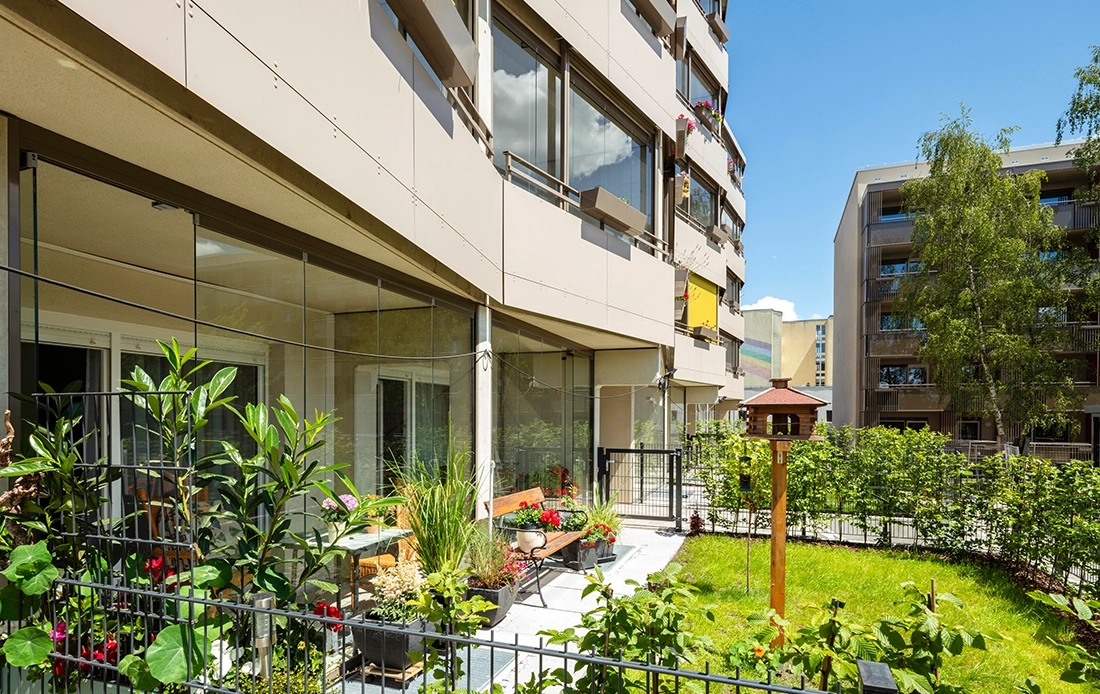
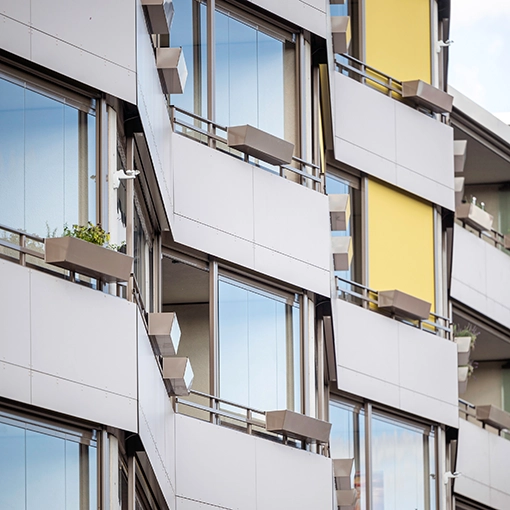
Glass fully or half open, sun protection lowered or not – in the added wintergardens, residents can control the climate and the atmosphere of their free space themselves.
Frank Schönert, Hütten & Paläste
Team Hütten und Paläste
Office Profile

Hütten & Paläste critically examine new fields of action as well as experimental strategies for sustainable space production in existing structures. They plan architectures that no longer follow the principle of expansion, but understand all existing resources (structural, social, climatic, etc.) as a starting point for open change processes as well as an opportunity for changed planning, building and use. The office was founded in 2005 by Nanni Grau and Frank Schönert. The work of Hütten & Paläste has been widely published and has been awarded the Brandenburg Baukultur Prize 2021, the German Sustainability Award for Architecture 2024 and as a finalist for the DAM Prize 2023, among others.
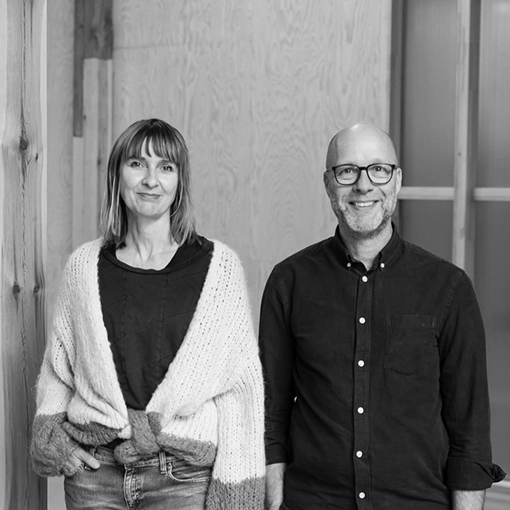
Nanni Grau and Frank Schönert, "Hütten & Paläste"

IBA Project Ossietzky Residential Courtyard in Nordhausen

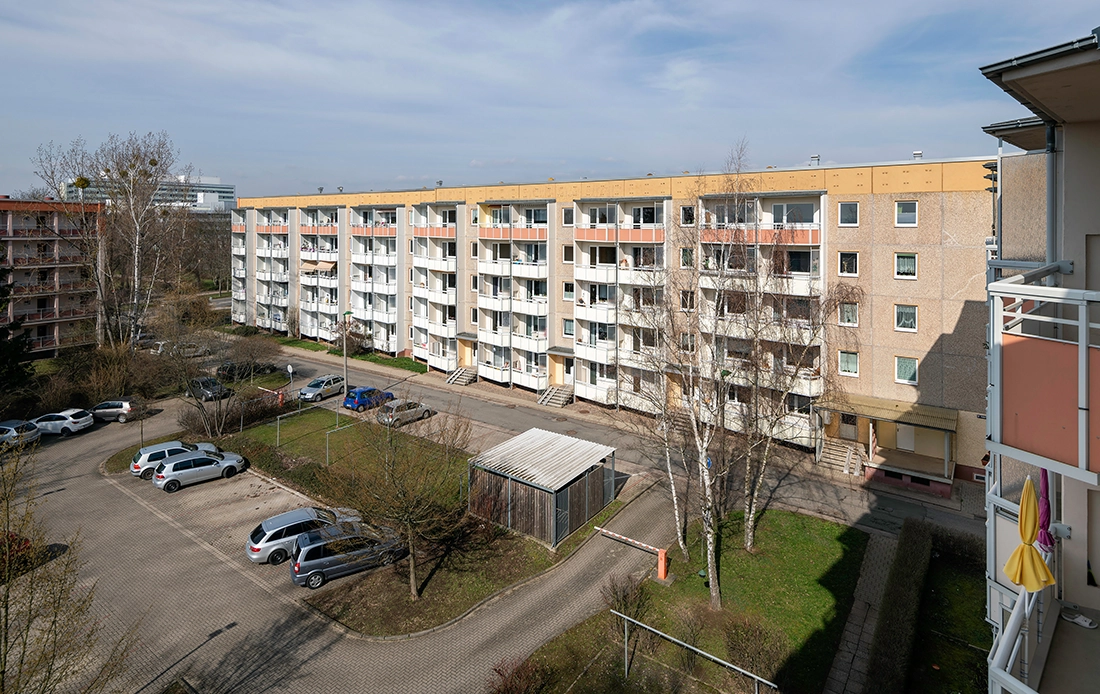
As the IBA Project Thuringia, a prefabricated housing estate from GDR times has been undergoing renovation since 2020. The Ossietzky courtyard in Nordhausen with the houses "Franzi", "Ludwig" and "Sophia" is exemplary for the preservation of the building fabric - the buildings were carefully developed and given a new architectural quality with the smallest possible interventions. In the case of "Ludwig", the architectural firm Hütten & Paläste succeeded in doing this in particular with an additive component: it expands the living space, serves as a balcony, loggia, and wintergarden at the same time, and contributes to energy generation as a climate buffer.

Balkonverglasung Ludwig

House "Ludwig" before modernization. This was built in 1980 as a prefabricated building "WBS 70". At that time, the inner courtyard served as a parking lot, without any further added value for the tenants.

Multi-talent wanted

In its architectural concepts, the architectural firm Hütten & Paläste generally considers the entire life cycle of a building. With such a sustainable approach, they impressed in 2018 in the realization competition "Multitalent gesucht" for the prefabricated housing district Nordhausen-Nord, organized by the municipal housing association in cooperation with the city of Nordhausen. The search was on for smart ideas that achieve the greatest possible effect with the smallest possible interventions.

Balkonverglasung Ludwig

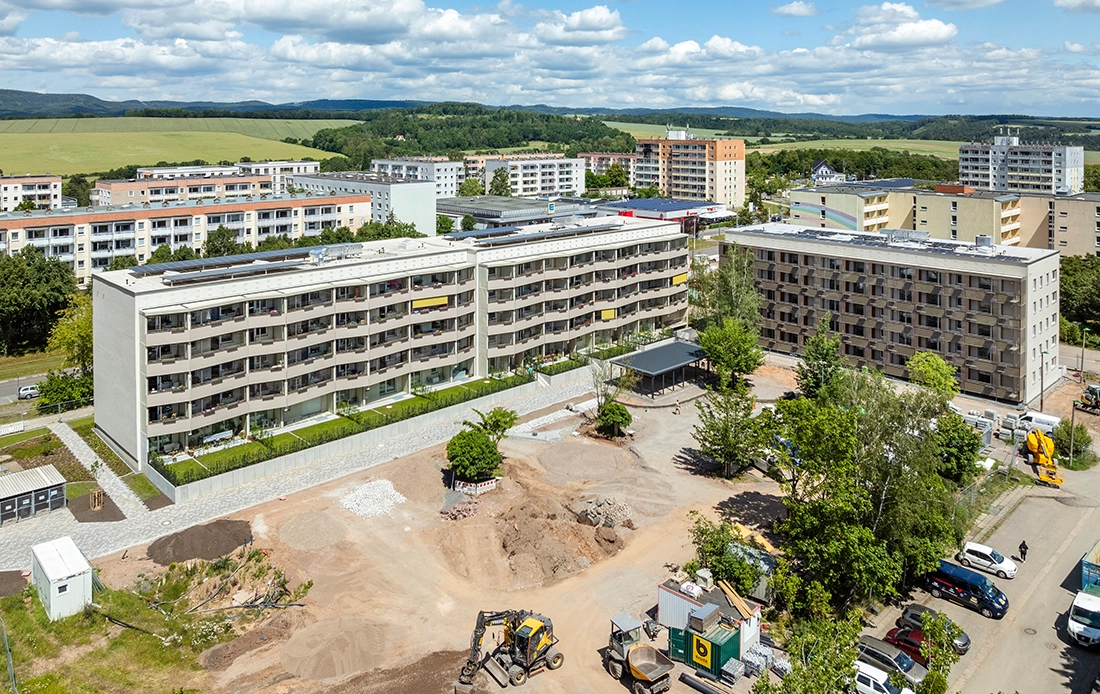
The buildings "Ludwig" and "Sophia" after their careful modernization.

The building names "Franzi", "Ludwig" and "Sophia" also come from the competition phase, which are intended to underline the change from uniform prefabricated buildings to individual living. Today, they are connected to each other by a common terrace zone, which enables barrier-free access. The terrace creates an intimate green interior that doubles as a rainwater buffer reservoir.

From monotonous prefabricated buildings to individual living

In the end, "Franzi" had to make way for an energy-plus house in timber construction due to excessively high pollution levels. Among other things, "Sophia" was modernized with maisonettes and a wide arcade to create a "flexible value-added panel" and upgraded to KfW Standard 85. The planners envisaged the fewest interventions for the "Ludwig A+B" building sections, which were renovated while they were inhabited: The adjacent five-story prefabricated buildings from 1980 were retained in their basic structure and now comply with KfW Standard 100 through a few but targeted measures.

The wave-shaped contour of the new balcony façade not only visually shortens the elongated structure, but also refracts the sun's rays.

Balkonverglasung Ludwig
Additive component

Although planned differently in the competition, the dilapidated existing balconies on the south side of "Ludwig" had to be demolished and replaced by an additive component. However, this measure brought with it new architectural qualities: the concrete modules presented extend the living space to the outside as private wintergardens. In addition, it is a design element "that promotes neighbourly communication," says Frank Schönert of Hütten & Paläste, "as two balconies are inclined towards each other."

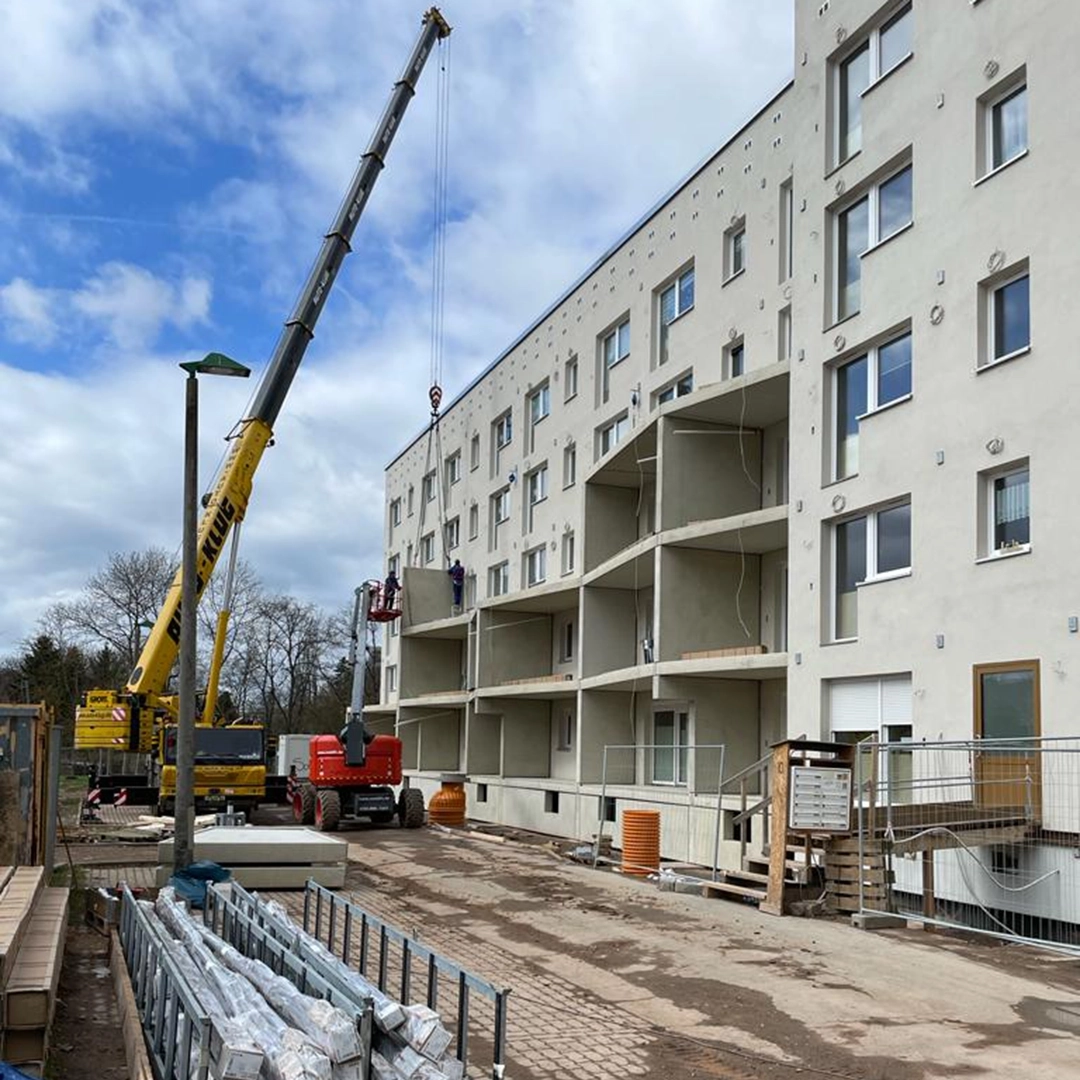
The new concrete modules were placed in front of the old building envelope.

Balkonverglasung Ludwig
Wintergardens as a climate buffer

The biggest advantage, however, lies in the creation of a climate buffer through movable glazing and large-scale shading elements. This climate buffer can be used as a wintergarden or terrace all year round, thus expanding the living space. It replaces conventional additional insulation and reduces the energy requirements of the apartments.

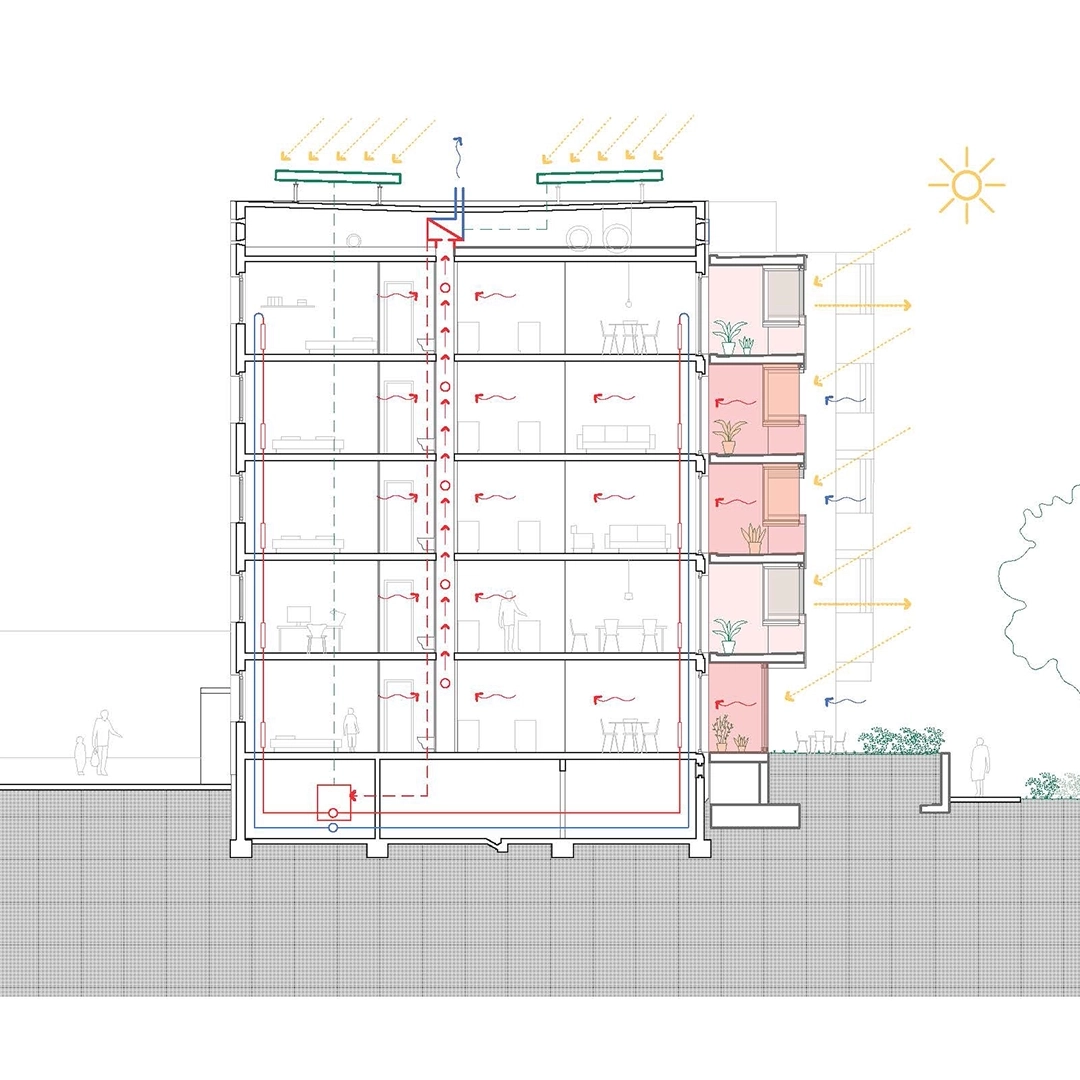
 The schematic representation shows the solar
energy generation in the "Ludwig" building.

Once the vertically frameless Proline T sliding and turning elements from Solarlux are closed, they become a climate buffer due to solar radiation and extend the outdoor season as wintergardens.

Different protection states

"Glass completely or half open, sun protection lowered or not – in the added wintergardens, residents can control the climate and atmosphere of their open space themselves," says Frank Schönert, summarizing the advantages of the additive component. He sees another positive effect in the fact that these are visible on the façade as individual actions of the residents, thus picking up on the basic idea of the design concept."

Balkonverglasung Ludwig

The new wintergardens not only increase the quality of living. The solar radiation also reduces the heating costs of the apartments.

Floor-to-ceiling or on parapet

In the ground floor flats, the conservatory glazing from the Proline T system by Solarlux was chosen to be floor-to-ceiling, creating a seamless transition into the gardens. On the upper floors, they are mounted on the parapets, a deliberate decision made in consultation with the building physicist to avoid excessive heat gain on sunny days. However, if it gets too warm or more fresh air is required, the glazing elements can be pushed aside by the residents and rotated by 90 degrees. They are parked as unobtrusive glass packages on the balcony partition walls. A narrow ventilation gap of just 3 mm between the vertically frameless elements ensures the necessary air exchange when closed.

Balkonverglasung Ludwig

The Ossietzky Quarter combines cost-effective construction with very good quality of living at affordable rents.

Climate-friendly district development

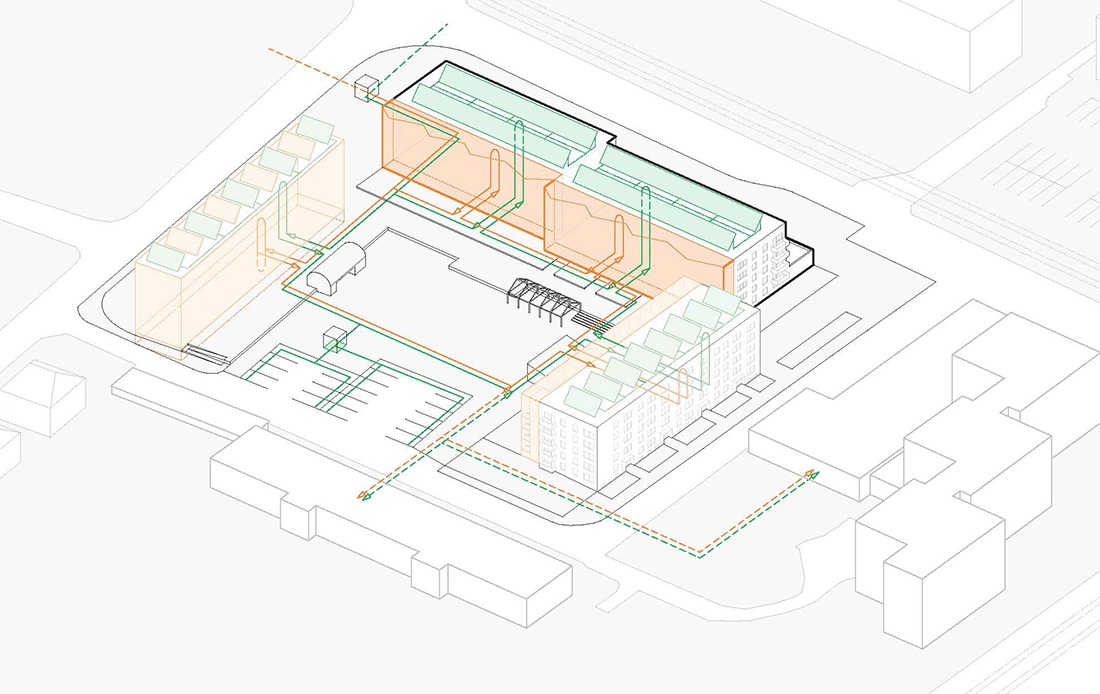
The energy concept was planned across all buildings and demonstrates the possibilities of climate-friendly neighbourhood development: Up to 44 percent of the energy required for heating and hot water will be generated on site in future. Photovoltaic systems were installed on the roofs of ‘Ludwig’ and ‘Sophia’ to supply the building services. ‘Ludwig’ is therefore heated with a mix of district heating and local renewable energy sources, while “Sophia” is heated with exhaust air heat pumps, with district heating only being switched on at peak times. The new ‘Ludwig’ conservatories also contribute to local energy generation. ‘Heat recovery via the climate buffers, geothermal energy and the large solar panels generate surplus energy. This has reduced the ancillary energy costs to around 70 percent,’ says Frank Schönert from Hütten & Paläste, explaining the benefits for the residents, who will be significantly less dependent on fluctuating energy prices in future.

Balkonverglasung Ludwig
Construction Info

Project: IBA-Komplexsanierung Ossietzky Hof, Haus Ludwig
Loctation: Dr. Robert-Koch-Straße 4-18, Nordhausen, Germany
Client: SWG Nordhausen, Städtische Wohnungsbaugesellschaft mbH Nordhausen
ARGE competition: Hütten & Paläste, ZRS Architekten Ingenieure, eZeit Ingenieure, schönherr Landschaftsarchitekten
Work phase 1-5: Hütten & Paläste, Schönert Grau Architects Part mbB, Berlin
Work phase 6-8: Architect Maurice Fiedler, Erfurt
Gross floor area: 7.200 m2
Completion: 2023
Product: Proline T slide and turn system
Building data: Built in 1980, prefabricated building type WBS 70, together with three commercial units on the ground floor and 74 flats, the building has a gross floor area of almost 5,500 square metres.

Drawings

Isometrics, section, floor plan and elevation: Copyright Hütten & Paläste

Advantages at a glance

Balcony glazing

You can use glass sliding or slide-and-turn systems to shelter yourself on your balcony – not just from harsh weather conditions such as wind, rain and cold, but also from noise. You can choose a fully transparent or a framed system, depending on your requirements. The versatile, non-insulated glazing will transform your balcony into an airy pergola or a sheltered room whenever you want. The wide range of system solutions can also be retrofitted onto existing balustrades. 

Order now: The brochure on balconies and façades
All systems and technical details in one brochure. This gives you access to all project-specific information on our balcony and façade solutions for new builds and renovations.