The commercial building in Kaufbeuren shows that cost-effectiveness and high architectural quality do not have to be mutually exclusive.
“
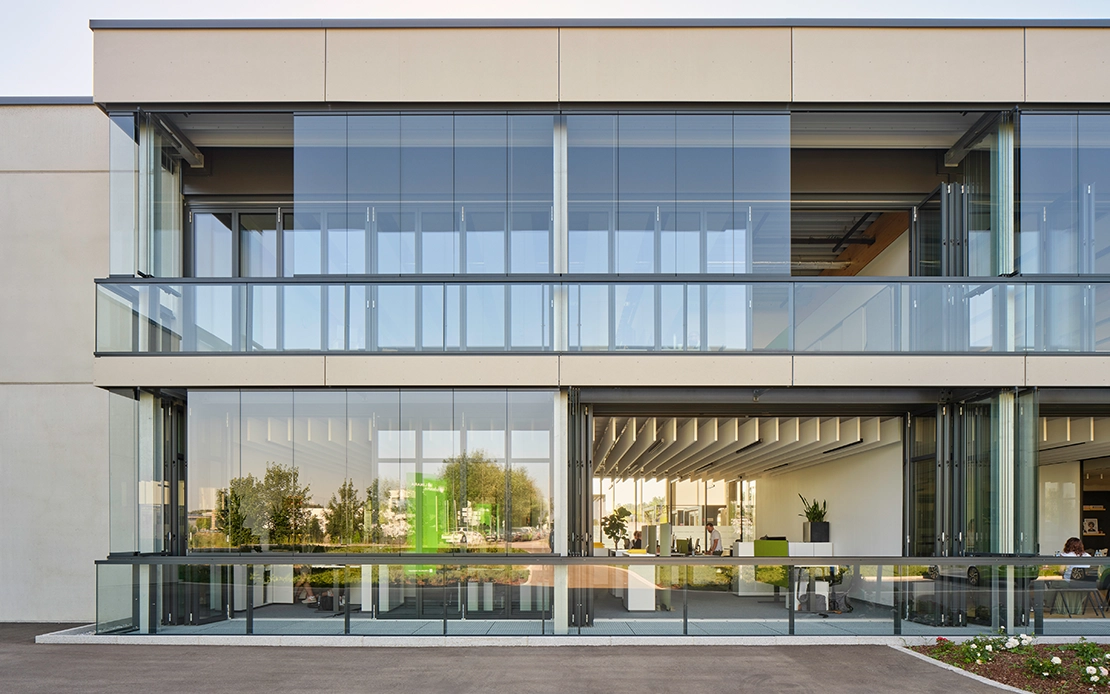
The principle of the climate-regulating double facade "Co₂mfort" was already developed in 2010 for the branch in Nijverdal and has since proven its flawless functionality.
Architecture in the context of corporate culture
The new "experience world" of the Allgäu-based building element dealer Linara in Kaufbeuren, a 100 percent subsidiary of the Solarlux Group, continues a series of architecturally high-quality industrial buildings of the group of companies. Following an administrative building for the Dutch branch in Nijverdal in 2010, the new construction of the Swiss subsidiary in 2012, and the Solarlux headquarters in Melle, Lower Saxony, in 2016, this is already the fourth new build that has been consistently realized with sustainability in mind.
As with the previous locations, this one is also intended to reflect an essential component of the corporate philosophy: transparency and openness to the outside world, combined with resource-efficient construction and optimal working conditions for the employees.
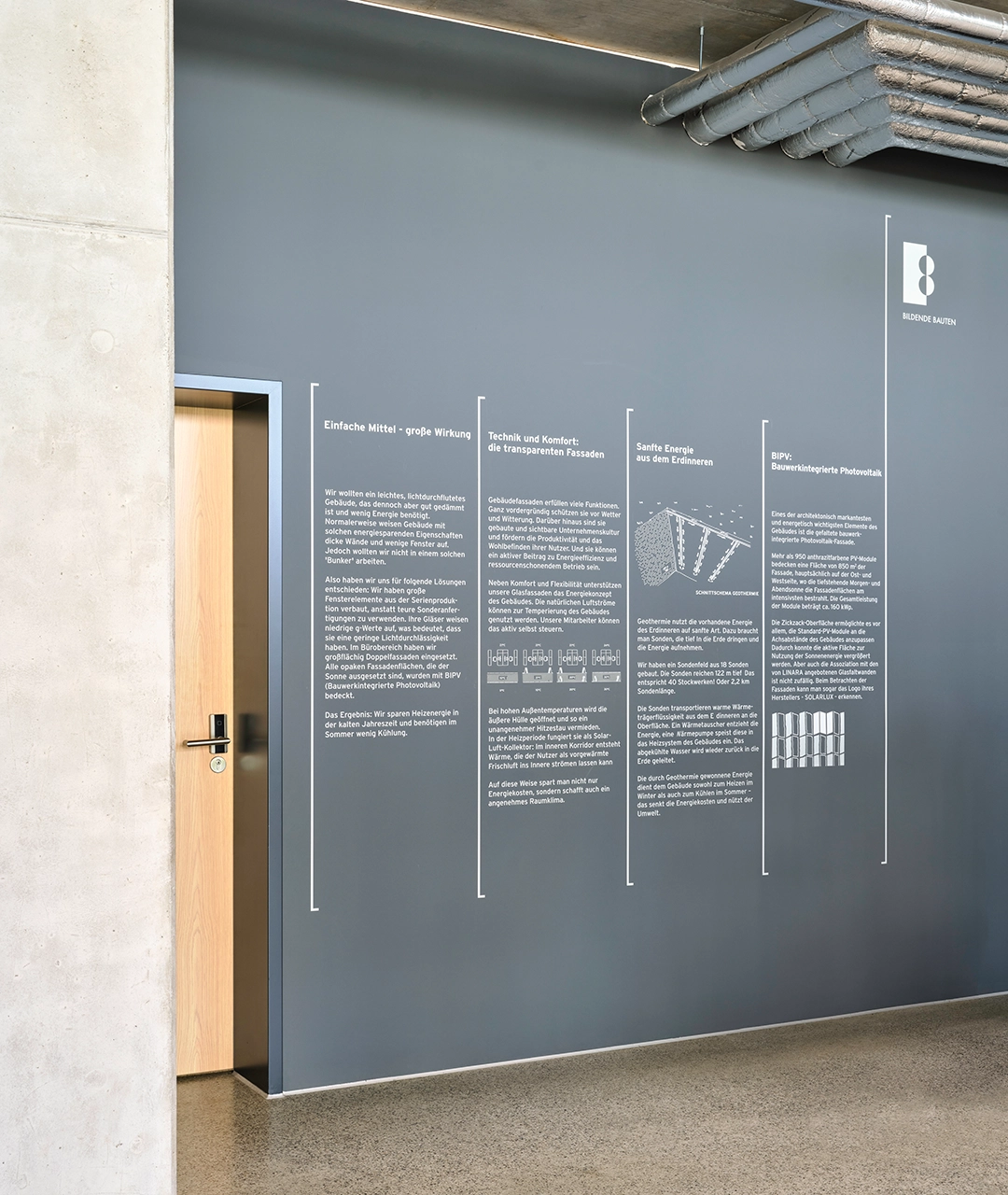
Shaping Structures
In addition, there is the concept of "educational building". The idea behind this is to make all technical and ecological connections visible to guests and staff by means of easy-to-understand information boards. Because geothermal energy happens just as secretly as the thermal concrete core activation or the low-tech function of a double-skin facade for natural air conditioning.
The elongated structure follows the natural course of the terrain and thus blends into the landscape.
Embedded in the topography
Taking ecological responsibility starts with open space planning – not a matter of course for industrial buildings in commercial areas close to cities, where the focus is usually on increasing productivity, efficient use of land, and keeping construction costs as low as possible. In Kaufbeuren, at the building element dealer Linara, a different approach was taken: The elongated structure, consisting of three clearly defined building sections for the showroom with office space, logistics hall, and workshop, which are grouped around a central staircase, follows the existing terrain and thus blends gently into the landscape.
Commercial use versus biodiversity
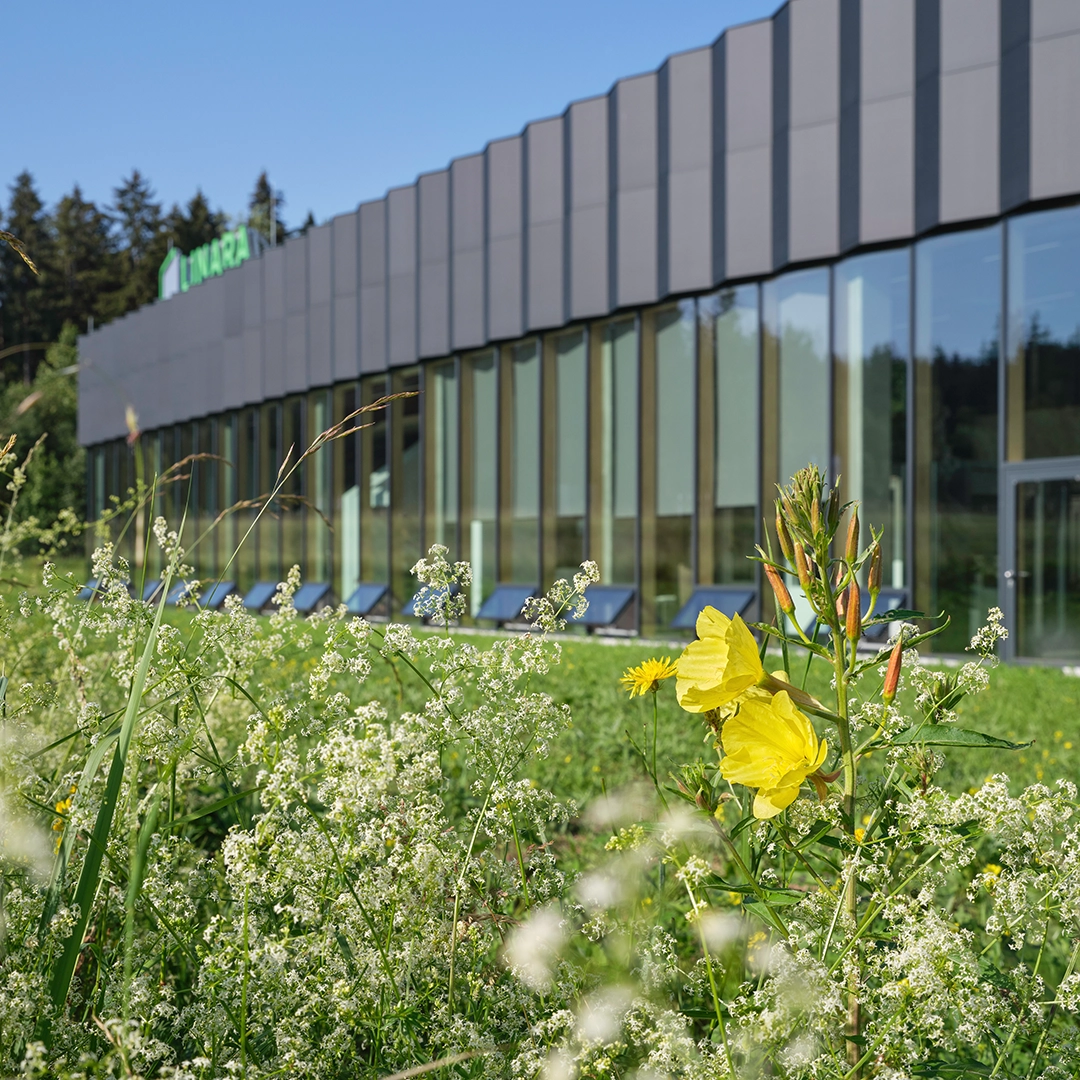
As an important contribution to the preservation of biodiversity, all open spaces that are not directly needed for operations have been created as insect-friendly hay meadows. This is because they are increasingly falling victim to intensive agriculture and the progressive sealing of land in the Allgäu. The settlement of bee colonies is planned. Around 500 square meters of green roofs do the rest.
Depending on the position of the sun, the PV modules rhythmize the building envelope or create the impression of a flat, homogeneous surface.
BIPV facades with optimal impact
For architect Dr. Peter Kuczia, the optimal effect of the PV modules was decisive for the design process, which could be achieved through the longitudinal orientation of the building from north to south. This way, the low sun on the west and east façades in the morning and evening optimally meets the building-integrated photovoltaics (BIPV). Since the modules are at an angle of 142 degrees to each other, the active PV area increases by another seven percent.
750 PV modules generate a total output of around 145 kWp on an area of 850 square meters. Moreover, the frameless, matte module panels protrude from the facade, making it appear visually shorter and at the same time more dynamic.
The insulated layer of the double facade consists of the Highline glass folding wall system, while the outer layer comprises Proline T sliding-turn elements, combined with the SL Plus all-glass balustrade.
Double-skin facade: low-tech instead of high-tech
As an architectural feature, the building's shell in the office landscape is designed as a double-skin facade, which enables individual and manual control of the indoor climate.
The outer, uninsulated and the inner, highly thermally insulated glass levels form a walkable façade corridor. If both levels are completely closed, they offer maximum thermal insulation. At the same time, this shell acts as a solar-air collector. Architect Peter Kuczia on the concept developed by Solarlux: "Depending on the weather, employees can unfold the glass bi-folding doors inside and let the preheated fresh air flow into their workspaces. This is especially beneficial on colder days. At high outside temperatures, only the outer sliding-turning elements are fully opened. This avoids heat build-up."
Building envelope: transparent and open
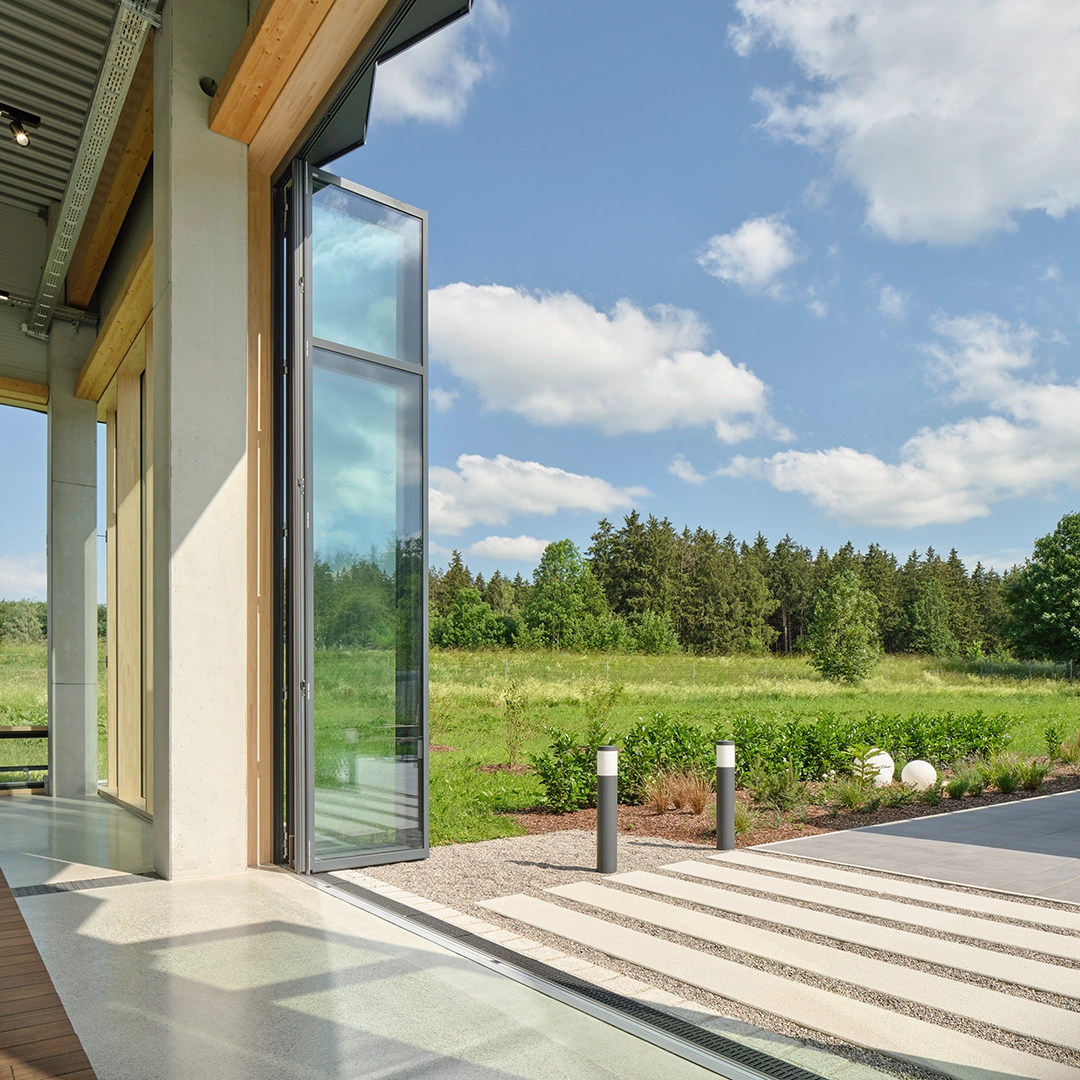
The new build in Kaufbeuren shows that a large-scale transparent building envelope also works energetically: glass bi-folding walls, the maximum sliding window cero and all-glass sliding and turning elements as well as post-and-beam facades made of wood-aluminium bring plenty of daylight and fresh air into the interior without heating up the rooms. "It's just a question of design, building materials, and the right products," says Peter Kuczia.
When the six elements of the Megaline glass folding wall are fully unfolded, they offer a seamless and barrier-free transition from the showroom to the outdoor exhibits.
Seamless transition from inside to outside
The topics of transparency and openness also played an essential role in the large exhibition hall. Architect Peter Kuczia: "The Megaline glass folding wall system, which has been integrated into the mullion-transom facade on the south side, offers visitors a generous transition to the outdoor exhibits. The individual folding elements of the six-part system are an impressive 4.90 m high and 1 m wide. Nevertheless, they are easy to open and close."
The faltBAR can be fully opened with floor-to-ceiling folding glass walls. It is a communicative meeting place for employees and the first point of contact for guests.
Retreat and communication zones
Designed as an open and modern office landscape, the new build offers around 40 ergonomically designed workplaces on two floors with very good acoustics, natural ventilation, and plenty of daylight. In addition, there are retreat and communication zones as well as a cafeteria on the ground floor, which serves both as a meeting place for employees and the first point of contact for guests.
Construction sign
Project: LINARA Kaufbeuren GmbH
Location: Bavariaring 22, 87600 Kaufbeuren
Client: Holtgreife Immobilien GmbH
Design: Architect Dr. Peter Kuczia
General Planning: Dobler GmbH & Co. KG Bauunternehmung, Kaufbeuren
Photovoltaics: 750 building-integrated PV modules for power supply on 850 m² façade area, total output: approx. 145 kWp
Building Technology: Concrete core activation and heating/cooling ceilings in connection with renewable energy systems (geothermal energy, heat pump)
Green Roof: 500 m²
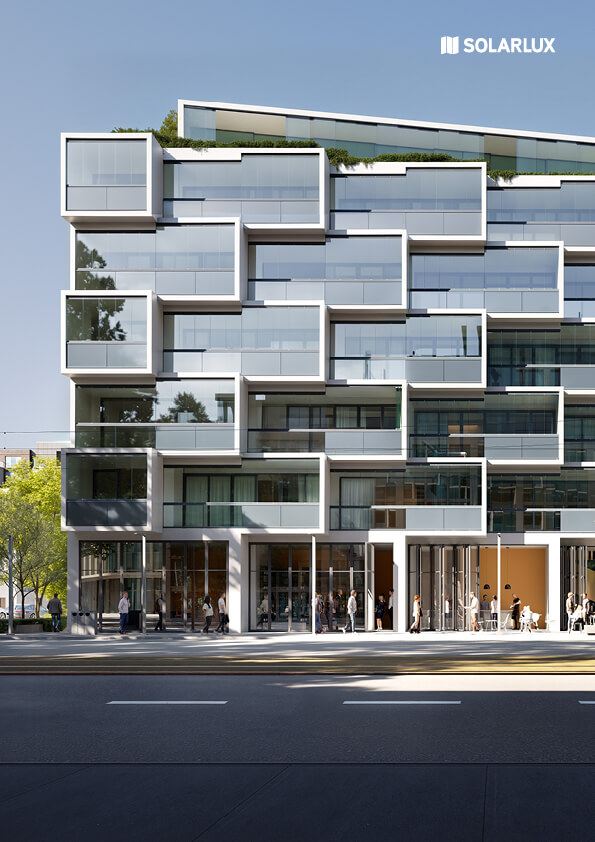
Order now: The brochure on balconies and façades
All systems and technical details in one brochure. This gives you access to all project-specific information on our balcony and façade solutions for new builds and renovations.
Order now: The bi-folding door brochure
Would you like to find out more about individual systems and technical details of our bi-folding doors? Then you are welcome to order our comprehensive product brochure.