Smooth transitions: past meets present
In many big cities, living space is at a premium. Spacious, open rooms are hard to find. The Netherlands in particular is famous for its narrow houses squeezed up close to one another. Rotterdam is a picture-perfect example of this architectural style. In order to make one terraced house more roomy, spacious and bright, FOAM Architects used large, moving glass fronts to expand the living space.
In one of the most upscale areas of the centre of Rotterdam stands a typical, red-brick, Dutch terraced house. Its deep basement and small rooms are characteristic of this traditional design. The interior is generally very dim, with small windows that don’t let in much light. When the house changed hands a few years ago, the wheels were quickly set in motion for a complete revamp. The new owner wanted to combine the two living units into one spacious, bright house that felt more open – but without losing the charm of the historical building.
New connections
But it would take plenty of ideas and a whole swathe of changes to reimagine the existing architecture. Construction firm Euroconstruct and Joren Vis of FOAM Architects worked together closely to ensure that the project matched the owner’s expectations. “Our speciality as an architects’ bureau is the renovation of this type of building,” Joren Vis reports. “Our designs always focus on retaining the original building, restoring typical elements and then combining those elements with a modern, contemporary design.” Since the ground floor was so cramped that there wasn’t enough space to put the kitchen and living room on the same floor, it was suggested right at the beginning of the planning phase that the bottom two floors could be used for this and joined together as seamlessly as possible.
“With the architecture, our aim was to restore the ambience and status of a late-nineteenth-century manor, but with a style that would suit the next century ahead of us,” explains architect Joren Vis. With this in mind, the team decided to make light and openness the key elements of the spatial design and merge the two floors into one.
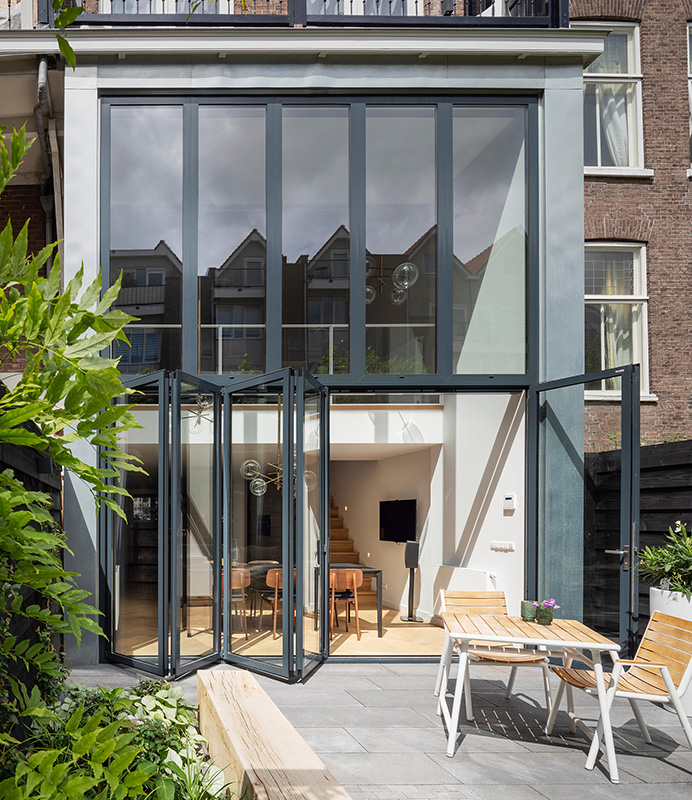
At the rear of the building, the room under the balcony provided enough space for a two-floor extension. Despite only being 1.5 metres in depth, the extension meant that the kitchen could be placed on the ground floor instead of in the basement, thus connecting to the living room on the first floor. The wall unit in the kitchen was integrated seamlessly into the oak stairwell that leads to the living room. In addition to this, the master bedroom, the bathroom and the dressing room on the top floor were joined together in a way that created as much openness as possible. Once the different floors and rooms had been combined successfully, the next step was to make the interior brighter.
The initial designs involved discussions around a trap window in the basement. This remained part of the design for a long time, but it quickly became clear that, with this solution, neither the kitchen nor the living room would be bright enough, and the connection between the two floors would not be open enough. As a result, FOAM Architects decided to use a Solarlux bi-folding door. Thanks to the existing balcony on the second floor, the conditions for the construction were already in place. Almost six metres in height, the glass front lends the interior a completely new sense of light.
Download the document for the full report.